Monday, September 20, 2010

Super Metroid Review


In 1986, Gunpei Yokoi created one of the most popular gaming franchises in history: Metroid. The game was a unique blend of Mario's platforming and Zelda's exploration that worked well, but it had a few big gameplay problems. The 1991 sequel, Metroid 2: Return of Samus, improved some of these (Especially with the Save System), but fans didn't imbrace it that well because of its linearity. 3 years later, Nintendo launched their biggest game at the time: Super Metroid. It not only improved on nearly every kink from the previous two, but is one of the greatest games ever to be made.

Warning: Spoilers ahead.

Super Metroid starts out right where Metroid 2 left off. Samus had mothered a Baby Metroid off of SR388, and brought it to the research center. Days later, Samus recieves a distress signal, and finds all the scientists are dead by the hands of her archnemisis, Ridley. He takes the Baby with him and you're left with a minute to escape the exploding facility. It's an epic beginning to a game that justs get better.

For starters, the controls rock. It was probably one of the only games of its time that allowed customizable controls. Samus herself moved swiftly and finesely, and shooting with her beams are no trouble at all, a godsend after the first game's twiddly traction. During the course of here adventure in Brinstar, she gets various weapons like the Ice Beam, Super Missiles, and Grappling Shot, all are insanely fun to use. The enemies in-game are hard enough not to be infuriating, and all have great design. The bosses in particular are insanely fun to fight.

The Overworld is massive, with a ridiculous number of collectibles to find, so thank the Metroid gods they included a map. It's a lifesaver in confusing locations, and with it, you can never go back to the older ones again. The pacing at which you get items is absolutely perfect, and the puzzles are extremelly innovative.

Brinstar and its locales are absolutely beautiful: the graphics took full advantage of the SNES's power. The music is also very enjoyable to listen to, because it sets the perfect mood for the dreary world.

Not every gem is without its chinks. Wall-jumping can be infuriatingly hard, there are places you can get genuinely stuck, and you can't go back to the overworld once you beat the Final Boss. Still, those are very minor problems.

VERDICT:
Gameplay: Insanely fun. Keeps you appealed until you beat it, and then some. 10
Graphics: Excellent. Takes full advantage of the system's power. 9.75
Audio: Tunes that set the mood for each area perfectly. 9.75
Overall: You have no excuse not to own this game. Not only is Super Metroid the best game from the 16-bit era, but explains why videogames are so fun to play: it's a giant world begging to be loved and explored.
10 out of 10

Saturday, September 4, 2010

Mario Kart Wii Review


In 1992, Nintendo launched a Mario Spin-off game that would become so popular, it created a whole new genre: Super Mario Kart. It was insane hybrid of go-karts and the Mario universe, only made better by the insanely competitive 2-player mode. Mario Kart 64 added two more to the fun in 1997, Mario Kart: Double Dash on Gamecube added a co-op element by putting another character behind your Kart, and Mario Kart DS allowed you to race anyone around the planet for the first time. Naturally, Nintendo's next step was to bring it to their newest console, the Wii. Mario Kart Wii had a lot to live up to, but what we got in the end is not only the best racer on the system, but the greatest game in the whole series.

The game introduced a bunch of new elements to the series; the biggest is shown right on the box. Mario Kart Wii comes with the Wii Wheel, a plastic case that slip around the remote, and is supposed to simulate you at the hands of the Kart wheel. At first, it takes awhile for series veterans to get used to the more lifelike control, but commit to it, and it becomes second-nature. Not only is the Wii Wheel a unique way to play, but it's a great way for casual gamers to get quickly into the series. (You can also choose between multiple other controls schemes like the GCN Controller and the Remote+Nunchuck a la Smash Bros, but I prefer the Classic Controller myself)

Two other big new editions are Bikes and Tricks. There's as many Karts as Bikes in this game, and they each play very differently. A Kart is better at turns and can charge its Mini-Turbo to a shiny orange, when released, gives you a nice long boost. Bikes, on the other hand, can only charge to the second stage of a Mini-Turbo (Blue), but can pop a wheelie any time by shaking the remote, making it better on straitaways. The differences may not be big at first, but they can mean the matter of wining or loosing. The new Tricks feature is a welcome addition: if you shake the wheel just as you exit a ramp or jump, your character does a cool little pose, and when they hit the ground, they gain a mini-turbo boost. The tricks are more powerful the higher the jump, but at the same time become harder to land.

There are 24 characters (including Miis) to choose from, each of which resides in a different weight category (Light, Medium, or Heavy), allowing you to use different types of Karts depending on who you chose. Unlike Mario Kart DS, everyone now shares the same types of vehicles, and the machine variety is well-balanced, making there no real "best car". The Track selection is at its best; 16 Tracks new to the game, 16 from all the older games. Since there are now 12 Karts on track at a time (4 more than usual), the tracks are wider, have opportunities for tricks, and are very fun to race on. Despite a flurry of big Karts on screen, the Retro tracks are still extremely fun to play.

All the traditional multiplayer modes remain like Vs. and Battle, along with a massively improved online play. Connecting with 12
other humans is fast and easy; and knowing you've thrown a Blue Shell at an actual person is extremely satisfying. The game even includes a free download of the Mario Kart Channel: a constantly-growing community where you can take part in MKDS-style weekly missions, race random Time Trial ghosts, and see how you stack up against the rest of the world on each track.

Mario Kart Wii isn't flawless though; with 4 more added on the track means more items everywhere, and it seems that the person in 1st is constantly being pelted with Lightning, Blue Shells, POW Blocks, and more. The cars seem to have much worse acceleration this time around; even lightweights can take awhile to start back up their motors to top speed. The Battle Mode is fun for a bit, but the option to turn off teams would be nice. There is a small bit of frame-skipping in Multiplayer, but it doesn't take much away from the actual game. Lastly, the new Lightning Cloud item is just an unwanted addition.

VERDICT
Gameplay: Polished to (Almost) Perfection. The developers finally got the Mario Kart formula down and completely nailed. 9.75
Graphics: Not the best on the Wii, but still has a variety of cool lighting effects. 8.0
Audio: Mario Kart music has always been enjoyable, and this is no exception. 9.0
Overall: With over 15 million units sold, it's no wonder this game is great; the new features like Bikes and great Online makes this game a joy either to play with yourself or with your buddies.
9.5 out of 10

Thursday, August 19, 2010

Megaman Battle Network 6 Review


In 2001, Capcom launched yet anohter new era in the Megaman legacy, this time turning the Blue Bomber into an RPG star. Players found out it was more than that, though; it was more like the crazy child of Final Fantasy and Yu-gi-oh. Players could select 30 different Battle Chips out of 200 total, each wildly different and could be used strategically. Unlike most RPGs, though, you had a 3 by 3 grid you could move around in, and so did your enemy. It all seems confusing at first, but with a bit of practice, the battles became second-nature. In a 6-year period, Capcom releaced, you guessed it, 6 different versions of the game. From 3 onwards, each game was split in 2 different versions (a la Pokemon). This Battle Network was the last one in the series, and Capcom went all-out making it the most enjoyable installment in the series.

The story is much more enguaging than the previous iterations. Lan Hikari and his netnavi Megaman Exe move to the wonderful city of Central Town, so every location is brand-new and look great, plus a bunch of new folks join the party. Things seem normal then onwards, but suddenly a Cyberbeast takes control of Megaman (Different for which game you have). After a bit, you gain control of the monster within you, and you get to "Beast Out" for 3 turns each battle, and your stats rise considerably. The Beasting Out feels underutilized story-wise, but in battle, can be used in a variety of awesome strategies.

The biggest feature BN6 adds is the Cross System, a massively improved version of the Soul Unison from 4 and 5. At any time you can fuse with one of 5 Navis (once again, different for each version of the game), and gain different strategies that seem small at first, but can mean the difference from victory to defeat.

This game also takes out some of the flaws that made other instalments in the franchise annoying. Besides the aftormentioned improved Cross System, the insanely hard Liberation missions from 5 are taken out, and replaced with small story moments that highly resemble them, but are MUCH more fun. The Navi Customizer also feels more fluid, the Graphics spiced up, the Audio restored to its glory days from the 2nd and 3rd game, all the Chips are excellent, the pacing is drastically improved, and the VS mode is at its finest.

Some of the Fatal Flaws have remained from the other games, though. Random Virus Battles, though not as frequent, still happen far too often, and some of the Requests on the Request Board are monotinously annoying. A minimalist run is considerably easier than the other games, but it makes up for this due to the insanely hard Post-Game.

VERDICT
Gameplay: Capcom polished it to near perfection. Some flaws keep it from reaching that goal, though. 9.25
Graphics: The Sprites have been polished up enough, but it stil isn't the greatest-looking GBA game, despite a variety of cool effects. 8.25
Audio: Stellar. It sounds as good as the 8-bit installment's legendary scores.
Overall: If you're new to the series or are an Battle Network expert, this is the one to get. With an insane ammount of content and fun, me and my friend haven't put this one down for weeks.
9.25 out of 10

Thursday, August 12, 2010

WarioWare: Touched! Review


Let's face it: the first couple of launch games for the DS weren't that good. The biggest one, Super Mario 64 DS, while fun, was just a demonstration of the graphical power of the DS. No game for a few months was a real must-have for the system... until WarioWare: Touched came around.

This game had a lot to live up for: not only was the first WarioWare for GBA a killer app for the system, it was one of the most innovative games of the decade. So, hence the title, the game uses the DS' Touch Screen and its other features. For those who are new to the series, WarioWare is the ultimante ADD game. It throws at you a random game that lasts 4-8 seconds. In that time period, you have to do a certain task, for example: there's a guy and a girl apart from each other. A small message says "Hook up!", so you have to draw a line to connect them, and the game is beat. When you re-encounter the same game later on, it gets harder by placing objects between the guy and the girl, and the timing in which you have to do it speeds up drastically. You only have 4 lives, and when you loose a game, you loose a life. Every 10 microgames or so, a Boss Stage appears, which lasts much longer than the other microgames. They are usually more complicated and harder, but if you beat them, you get an extra life. This is the perfect pick-up and play game, where you can play for 3 minutes or 3 hours at a time.

Each of Touched's 180 Microgames is split up into different sections, hosted by different people. One batch may require you to make circles on the Touch Screen for each of the games, the other may having you do slicing motions with the Stylus. The most enjoyable ones, though, are 9-Volt's games, which are all based off Retro Nintendo games. Some microgames are insanely strange, bizzare, and hilarious, which adds to the fun-filled time you'll have with the game.

Beating certain objectives in the game unlocks you different applications, which are almost similar to most of the freeware stuff on Apple's own App Store. Like that, they probably won't hold your interest for over 2 minutes, but some games (like the Pyroro Challenge) take good advantage of the Touch Screen and are insanely addictive.

The Graphics are excellent, and are a massive improvement over the GBA games. The music is infectiously catchy, and the game even features full-length tracks that are sung beautifully (like Ashley's Theme). The voice acting is spot-on, too, without being too obnoxious.

Like the other WarioWares, though, this game suffers from the problem of being far too short. The Story Mode won't take a seasoned gamer over a day to complete, but the game makes up for it with its replay value: playing each section over again until you've unlocked all the games for it. Also, the unskippable Story Mode cutscenes last far too long and can drag on.

VERDICT
Gameplay: There are barely any games that are a dud, and are very fun to play and replay. 9.5
Graphics: Uses both the handheld's 2D and 3D to a beautiful effect. 9.0
Audio: Beats you'll be bopping your head to in seconds. 9.0
Overall: Besides DIY, this is easilly the best entry in the series. If you want a break from all other games, this should be a must-buy on your list.
9.25 out of 10

Wednesday, July 7, 2010

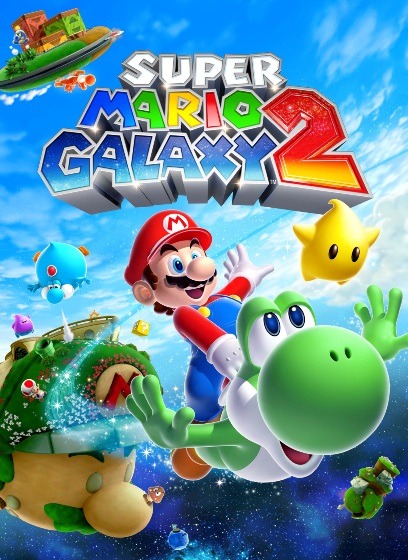
Super Mario Galaxy 2 Review


In 2007, Nintendo launched Super Mario Galaxy for the Wii, and it wowed critics, with its innovative Gravity gimmick and supersmart cameara. While I enjoyed Galaxy, it didn't have the certain spark I expect from Mario games (such as an actual challenge, Galaxy 1 was far too easy), and I preferred Super Mario Sunshine over it. With that, I went into Galaxy 2 with caution, expecting no more than, well, more of the same. While that it is, everything is improved to perfection.

The story starts out regularly: Peach gets kidnapped by a Giant-sized Bowser, and Mario must save her. The plot was one of the things I didn't like in Galaxy 1, in any other game it would feel fine, but in a game filled with talking Mushroom heads and turtles that squawk like birds, it felt too out-of-place. Galaxy 2 simplifies it down, and that's way things should be. You eventually meet up with a fat Luma called Lubba, and sees you are the hero of the cosmos, so he fashions a ship shaped like Mario's head, which he dubs "The Faceship." With the Faceship comes a new way of getting to levels: it is set up more like the 2D Mario Overworlds, so getting to levels are fast and easy. The ship itself is smaller than the Comet Observatory from Galaxy 1, which is good, because the Observatory was far too large and hard to get around.

But you didn't buy this game to see how to get to a level, you bought it because of the levels, and on that front, this game delivers. The levels are even more linear than the first games', which I thought would be a negative, but what is in them is more fun and challenging than ever before. The Level Design is excellent, an expected from Nintendo. The camera is still scary-smart, and the controls feel a bit more comfortable than the first game's, due to the better level design.

Perhaps the biggest new feature is Yoshi, who controls great. His tounge and eating powers are used in a handful of innovative ways, such as sticking his little licker onto a peg and swinging across it Indiana Jones-style, or eating a variety of fruits to float, go super fast, etc. Another positive about him is that he appears fairly often: that was one big problem for me in New Super Mario Bros. Wii: he was only used in less than 8 levels. Here, he's used in over 16 of them, and levels with him are always a fun time.

The other big new feature is the power-ups: The Rock Mushroom, Spin Drill, and the Cloud Flower. The Rock Mushroom allows Mario to roll around like a bowling ball, and is fairly fun to use. The Spin Drill and Cloud Flower, however, are a work of genius. The drill allows Mario to, well, drill into the planet's surface, setting up a variety of innovative puzzles. The Cloud Flower lets Mario create fluffy platforms whenever he spins. It's the most used item in the game, and deservedly so: it's easilly one of his greatest power-ups ever. Returning items like the Bee, Boo, and Spring Mushroom are not used very often, and that's good: I've had enough of Mario's infernal springing.

You can't really complain about a lack of challenge: this game assumes you already got down the basics of gravity and all the other gimmicks in the first Galaxy, and elevates them tenfold. Getting the 70 stars on the initial run is fairly tough, but getting all 120 is one of the hardest Mario experiences ever. And, (spoiler), even after you're done getting the 120 stars, you've still got more to do. This is truly not for the faint of heart.

The music is nothing to complain about, either. From the Jazzy tunes of the Spin Dig Galaxy to the sweeping orchestral opening in the Sky Station Galaxy, this game's soundtrack is absolutely phenomenal. And just like in Galaxy 1, old Mario tunes get a whole new limelight. The Graphics also look beautiful, too. There's never a hint of slowdown, and you always know what everything is.

This game has a few minor problems. Most of the Comet Challenges are fun (now activated by collecting Comet Metals in each level), but some are more frustrating than fun. Also, you can't skip the dialogue, so having to hear Lubba tell you every ten minutes to take a break can get pretty annoying. These are minor issues, as the game in whole is well-polished and very fun.

VERDICT
Gameplay: Greatly improved over the original. The levels are all interesting, and the new power-ups are very fun to use. 9.75
Graphics: Looks on-par with a PS3 game, maybe even better. 10
Audio: Fantastic. Your ears will thank you. 10
Overall: This is an extremelly fun game that is yet another worthy installment in the treasured Mario franchise. If you own a Wii, you must buy this game.
10 out of 10

Monday, May 3, 2010

PixelMan's Flash Game Early Demo Review

In 2010, PixelMan decided to make a Flash Game with elements of multiple games. So far it's not complete yet, but from what I've played it could be the real bee's knees.

You start as a lone ninja who wants to collect all of his power-ups and reach the Win Screen. The game controls like a great NES game: X to jump, and C in various directions to use different weapons. These power-ups are useful and intuitive.

The Graphics are very fluid and nice. Pix's a really good sprite artist. But I hope he can add music and varied difficulty settings.

VERDICT:
Gameplay: Great. Fluid and fun. 9.0
Graphics: Great also. 9.0
Audio: Nonexistent as of now. Not Rated
Overall: Pix's game is very fun. I'm exited to see the final result.
9.0 out of 10

Friday, April 30, 2010

Kirby Super Star Ultra Review


In 1996, Nintendo released what became one of the many cult hits on the SNES: Kirby Super Star. Often regarded as the best game in the series, HAL decided to redo the game 12 years later on the DS, and what came out is arguably one of the Best DS games ever to be releaced.

Kirby Super Star Ultra's main selling point is its inclusion of multiple games. I'll be going through each games, telling you which ones are the best.

Spring Breeze: A remake of Kirby's Dreamland on the Game Boy. It's only 4 short levels. Once you play through it once, you'll most likely not come back to it.

Dyna Blade: Now you can walk around a world map and choose about 6 levels, each much larger than Spring Breeze's. There's secrets in each world, but once you complete this, there's not much incentive to go back to it.

The Great Cave Offensive: This is where the games get good. You're trapped in one HUGE mine and are tasked with collecting all 60 treasure chests. You can beat it without getting a single chest, but if you want to 100% the whole game (and trust me, you do), finding all the treasures can be a gruelingly hard task. It would've been nice if there was a more detailed map at the bottom screen a la Kirby and the Amazing Mirror, but this is still a fun game.

Gourmet Race: A collection of three races against Dedede. You can go for Time Trials and the highest score, but playing it with a friend is way more fun.

Revenge of Meta-Knight: You go through about 10 timed levels, and when you beat a level, you destroy different parts of the Halebird. It's fast and frantic fun, and the dialoge that spreads out on the bottom screen is often times humorous.

Milky Way Wishes: There are 7 levels you can choose from, but they're harder than previous ones and with a huge new gameplay mechanic: Kirby has lost his power to copy abilites, so he must collect various "Copy Cards" that allow him to use an ability anytime by tapping it on the bottom screen. This is a great mechanic and it's a lot of fun to test every single one of each abilities attacks.

Revenge of the King: A significantly enhanced version of Spring Breeze, now it is a lot harder, and more fun. The starship battle against Kabulla is especially fun.

Meta Knightmare Ultra: You play through Spring Breeze, Dyna Blade, Great Cave Offensive, Revenge of Meta-Knight, and Milky Way Wishes as Meta Knight, and try to beat them as fast as you can. Playing as Meta-Knight is a blast, and by defeating enemies he gains "Order Points", which can allow him to do simple things like calling out a Helper Knight to killing everything on the screen with an awe-inspiring Mach Tornado.

The Arena: You go through 19 bosses in a row with only one life and 5 Maximum Tomatoes as fast as possible. It's pretty hard, but nowhere near the challenge as the later arena.

Helper to Hero: Instead of playing as Kirby, you play as one of about 20 Helper friends, which are basically manifestations of his Copy Abilites. It is slightly easier than the Arena, and you get a top-secret video if you beat it as each of the Helpers.

The True Arena: Oh boy. This is without a dought the hardest challenge in the series, because you have to face all-revamped versions of the previous Arena Challengers, and they can inflict massive ammounts of damage. Add that to the fact that you only have 4/5 of a M Tomato to heal with, and only one ability to choose from between rounds, and you'll be throwing your DS across the room in no time. But it's hard in the way that's addictive, and you'll be playing it again and again even after you beat it.

There's also multiple smaller Mini-games, and these are great to play in a party atmosphere.

VERDICT
Gameplay: They improved on the original and refined it even more. Massive fun. 9.75
Graphics: The 2D animations look spectacular, and the 3D cutscenes look Gorgeous. 9.5
Audio: It's the Kirby standard: Brilliant. 9.5
Overall: If you love Kirby, Platformers, or like well-adjusted Difficulties, you must play this game. This is the little Pink Puffball at his finest.
9.5 out of 10