Wednesday, July 7, 2010

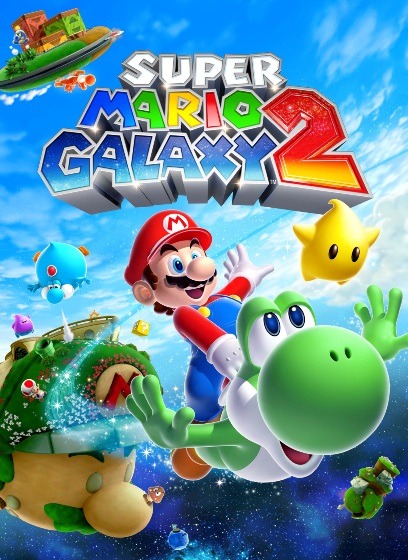
Super Mario Galaxy 2 Review


In 2007, Nintendo launched Super Mario Galaxy for the Wii, and it wowed critics, with its innovative Gravity gimmick and supersmart cameara. While I enjoyed Galaxy, it didn't have the certain spark I expect from Mario games (such as an actual challenge, Galaxy 1 was far too easy), and I preferred Super Mario Sunshine over it. With that, I went into Galaxy 2 with caution, expecting no more than, well, more of the same. While that it is, everything is improved to perfection.

The story starts out regularly: Peach gets kidnapped by a Giant-sized Bowser, and Mario must save her. The plot was one of the things I didn't like in Galaxy 1, in any other game it would feel fine, but in a game filled with talking Mushroom heads and turtles that squawk like birds, it felt too out-of-place. Galaxy 2 simplifies it down, and that's way things should be. You eventually meet up with a fat Luma called Lubba, and sees you are the hero of the cosmos, so he fashions a ship shaped like Mario's head, which he dubs "The Faceship." With the Faceship comes a new way of getting to levels: it is set up more like the 2D Mario Overworlds, so getting to levels are fast and easy. The ship itself is smaller than the Comet Observatory from Galaxy 1, which is good, because the Observatory was far too large and hard to get around.

But you didn't buy this game to see how to get to a level, you bought it because of the levels, and on that front, this game delivers. The levels are even more linear than the first games', which I thought would be a negative, but what is in them is more fun and challenging than ever before. The Level Design is excellent, an expected from Nintendo. The camera is still scary-smart, and the controls feel a bit more comfortable than the first game's, due to the better level design.

Perhaps the biggest new feature is Yoshi, who controls great. His tounge and eating powers are used in a handful of innovative ways, such as sticking his little licker onto a peg and swinging across it Indiana Jones-style, or eating a variety of fruits to float, go super fast, etc. Another positive about him is that he appears fairly often: that was one big problem for me in New Super Mario Bros. Wii: he was only used in less than 8 levels. Here, he's used in over 16 of them, and levels with him are always a fun time.

The other big new feature is the power-ups: The Rock Mushroom, Spin Drill, and the Cloud Flower. The Rock Mushroom allows Mario to roll around like a bowling ball, and is fairly fun to use. The Spin Drill and Cloud Flower, however, are a work of genius. The drill allows Mario to, well, drill into the planet's surface, setting up a variety of innovative puzzles. The Cloud Flower lets Mario create fluffy platforms whenever he spins. It's the most used item in the game, and deservedly so: it's easilly one of his greatest power-ups ever. Returning items like the Bee, Boo, and Spring Mushroom are not used very often, and that's good: I've had enough of Mario's infernal springing.

You can't really complain about a lack of challenge: this game assumes you already got down the basics of gravity and all the other gimmicks in the first Galaxy, and elevates them tenfold. Getting the 70 stars on the initial run is fairly tough, but getting all 120 is one of the hardest Mario experiences ever. And, (spoiler), even after you're done getting the 120 stars, you've still got more to do. This is truly not for the faint of heart.

The music is nothing to complain about, either. From the Jazzy tunes of the Spin Dig Galaxy to the sweeping orchestral opening in the Sky Station Galaxy, this game's soundtrack is absolutely phenomenal. And just like in Galaxy 1, old Mario tunes get a whole new limelight. The Graphics also look beautiful, too. There's never a hint of slowdown, and you always know what everything is.

This game has a few minor problems. Most of the Comet Challenges are fun (now activated by collecting Comet Metals in each level), but some are more frustrating than fun. Also, you can't skip the dialogue, so having to hear Lubba tell you every ten minutes to take a break can get pretty annoying. These are minor issues, as the game in whole is well-polished and very fun.

VERDICT
Gameplay: Greatly improved over the original. The levels are all interesting, and the new power-ups are very fun to use. 9.75
Graphics: Looks on-par with a PS3 game, maybe even better. 10
Audio: Fantastic. Your ears will thank you. 10
Overall: This is an extremelly fun game that is yet another worthy installment in the treasured Mario franchise. If you own a Wii, you must buy this game.
10 out of 10

Monday, May 3, 2010

PixelMan's Flash Game Early Demo Review

In 2010, PixelMan decided to make a Flash Game with elements of multiple games. So far it's not complete yet, but from what I've played it could be the real bee's knees.

You start as a lone ninja who wants to collect all of his power-ups and reach the Win Screen. The game controls like a great NES game: X to jump, and C in various directions to use different weapons. These power-ups are useful and intuitive.

The Graphics are very fluid and nice. Pix's a really good sprite artist. But I hope he can add music and varied difficulty settings.

VERDICT:
Gameplay: Great. Fluid and fun. 9.0
Graphics: Great also. 9.0
Audio: Nonexistent as of now. Not Rated
Overall: Pix's game is very fun. I'm exited to see the final result.
9.0 out of 10

Friday, April 30, 2010

Kirby Super Star Ultra Review


In 1996, Nintendo released what became one of the many cult hits on the SNES: Kirby Super Star. Often regarded as the best game in the series, HAL decided to redo the game 12 years later on the DS, and what came out is arguably one of the Best DS games ever to be releaced.

Kirby Super Star Ultra's main selling point is its inclusion of multiple games. I'll be going through each games, telling you which ones are the best.

Spring Breeze: A remake of Kirby's Dreamland on the Game Boy. It's only 4 short levels. Once you play through it once, you'll most likely not come back to it.

Dyna Blade: Now you can walk around a world map and choose about 6 levels, each much larger than Spring Breeze's. There's secrets in each world, but once you complete this, there's not much incentive to go back to it.

The Great Cave Offensive: This is where the games get good. You're trapped in one HUGE mine and are tasked with collecting all 60 treasure chests. You can beat it without getting a single chest, but if you want to 100% the whole game (and trust me, you do), finding all the treasures can be a gruelingly hard task. It would've been nice if there was a more detailed map at the bottom screen a la Kirby and the Amazing Mirror, but this is still a fun game.

Gourmet Race: A collection of three races against Dedede. You can go for Time Trials and the highest score, but playing it with a friend is way more fun.

Revenge of Meta-Knight: You go through about 10 timed levels, and when you beat a level, you destroy different parts of the Halebird. It's fast and frantic fun, and the dialoge that spreads out on the bottom screen is often times humorous.

Milky Way Wishes: There are 7 levels you can choose from, but they're harder than previous ones and with a huge new gameplay mechanic: Kirby has lost his power to copy abilites, so he must collect various "Copy Cards" that allow him to use an ability anytime by tapping it on the bottom screen. This is a great mechanic and it's a lot of fun to test every single one of each abilities attacks.

Revenge of the King: A significantly enhanced version of Spring Breeze, now it is a lot harder, and more fun. The starship battle against Kabulla is especially fun.

Meta Knightmare Ultra: You play through Spring Breeze, Dyna Blade, Great Cave Offensive, Revenge of Meta-Knight, and Milky Way Wishes as Meta Knight, and try to beat them as fast as you can. Playing as Meta-Knight is a blast, and by defeating enemies he gains "Order Points", which can allow him to do simple things like calling out a Helper Knight to killing everything on the screen with an awe-inspiring Mach Tornado.

The Arena: You go through 19 bosses in a row with only one life and 5 Maximum Tomatoes as fast as possible. It's pretty hard, but nowhere near the challenge as the later arena.

Helper to Hero: Instead of playing as Kirby, you play as one of about 20 Helper friends, which are basically manifestations of his Copy Abilites. It is slightly easier than the Arena, and you get a top-secret video if you beat it as each of the Helpers.

The True Arena: Oh boy. This is without a dought the hardest challenge in the series, because you have to face all-revamped versions of the previous Arena Challengers, and they can inflict massive ammounts of damage. Add that to the fact that you only have 4/5 of a M Tomato to heal with, and only one ability to choose from between rounds, and you'll be throwing your DS across the room in no time. But it's hard in the way that's addictive, and you'll be playing it again and again even after you beat it.

There's also multiple smaller Mini-games, and these are great to play in a party atmosphere.

VERDICT
Gameplay: They improved on the original and refined it even more. Massive fun. 9.75
Graphics: The 2D animations look spectacular, and the 3D cutscenes look Gorgeous. 9.5
Audio: It's the Kirby standard: Brilliant. 9.5
Overall: If you love Kirby, Platformers, or like well-adjusted Difficulties, you must play this game. This is the little Pink Puffball at his finest.
9.5 out of 10

Monday, April 26, 2010

Mega Man Review


Fledgling game company Capcom in 1987 came out with a revolutionary game: Rock Man. His first game shot in popularity and soon Rock Man became massively popular. Capcom tried to duplicate it in America, and to rowsing success.

The premise was simple, yet addictive: Choose one of the 6 bosses, beat their level and get their weapon, and repeat. But the real charm came in the Boss Order: using certain weapons on certain bosses, they would fall incredibly easily. The Weapons were cool and effective: The Lightning Strike remains one of the best weapons in Mega Man history. The game played like a Metroid, minus the open world. It's also notorious for being insanely hard. Until Mega Man 9 came, this was the hardest game in the series.

The game also introduced another popular addition to the series: its awesome music. The soundtrack pushed the NES to its max, and is still a joy to listen to today.

The game has gotten several scars through the test of time, though. It's far too short, has little to none bonuses, and may turn people off with its insane hardness. Still, it's a solid play.

VERDICT:
Gameplay: Fun. The Mega Man formula still shines. 8.5
Audio: As expected, Rock-awesome. 9.5
Overall: If you're a newb to the series, get Mega Man 2 first. But if you've already played or beaten another Mega Man, this is a great way to see where the series started.
8.5 out of 10

(And if you thought I would show the American NES boxart, well, you're crazy :P)

Friday, April 23, 2010

Wario Ware: D.I.Y. Review


In 2003, Wario made a huge splash on the Game Boy Advance with a great new idea: a collection of microgames, each lasting 5 seconds. This proved so popular Nintendo releaced 4 sequels, but in 2010, they decided to take the already innovative concept even further: by allowing you to make the games.

Wario Ware D.I.Y. starts out by you playing a couple of microgames, then Wario assigns you a monster in his game: Wario Quest. The creativity barely starts there. If you try to create a game immediatly, the game forces you watch the tutorial. Trust me, you'll need it. The game's creation objects are nearly endless. You can create a game that's just about tapping one object, or make a game with graphics and gameplay that would make anyone else go into pure awe. Whatever you want to make, it's all up to you. The tutorials are not boring, and are filled with funny bits from impatient Wario.

The premade microgames are still pretty fun. They range from reflex games, sports games, retro games, and more. Orbulon's games are definitely the hardest, you almost feel like you're playing a Brain Age game when they're on. Probably the best part about the premade microgames is that you can see how they were made, and use those tips to help in your game-creating.

If you get bored of the Game Maker, DIY also offers you an extensive Music Maker, with a whole lot of note options. You can also make custom comics, which are more like still-frames from the Flipnote Studio due to the fact you can only draw in Black and White.

One of the biggest draws to this game is the Distribution Center, where you can share your microgames with friends and enter special design contests. And every week Nintendo allows you to play Superstar games, microgames made by world-famous game creators like Matt Bozon and Sakurai.

The game as a whole is pretty good-looking, and with the right effort, your games can look amazing, also. The music is nice, but no tracks really stick out. The audio is also Ok, but I still feel that Wario's friends deserve a little better voice actors.

Some minor flaws to this game are its color pallete isn't really that great, there could've been more pre-made microgames, the friend codes are still annoying, and you have to pay for Wario Ware D.I.Y. Showcase on WiiWare. C'mon, that should've been free if you have the DS game!
OVERALL
Gameplay: An insanely robust game, music, and comic maker spreads the longevity of this game. The premade microgames are pretty fun, too. 9.25
Graphics: It works. Nothing that spectacular. 7.0
Audio: Excluding the Music Maker, the Audio is fairly sub-par. 7.0
Overall: This game feels like Mario Paint for a new generation. Once you play this game, you can't stop. Easilly one of the best games on the DS.
9.25 out of 10

Thursday, April 15, 2010

Bleach: Dark Souls Review


In 2001, Tite Kubo made a brand-new manga that would become one of the most popular in its history: Bleach. It was about Soul Reapers (Shinigamis in the Japanese version) that would deal with evil spirits called Hollows. To state the whole plot of Bleach would take a milenia, but what you really need to know is it is an awesome Anime/Manga definitelly worth your time. But with a popular franchise comes the inevidable licenced crappy game. But Sega knew this would come, so they hired one of the best action game producers, Treasure, to make a Bleach game. The first game, Blade of Fate, became a smash-hit on the DS, and Treasure handeled the sequel, improving it on almost every way.

(Warning: Spoilers ahead)
The game's main story takes place at the very end of the show's third season. A mod soul, Kai, is trying to release all of his bretherin, but ends up causing a massive Hollow invasion in the process. So, Ichigo and friends jump to the action to stop this chaos. The story is set up like Star Fox Command, with multiple branching paths. Treasure knew players would have to play through the game multiple times to get 100%, so they allowed the option to skip events you already played, saving a lot of time. (Though you won't get a money award like usual) The story mode is relatively short and can be completed in about 5 hours.

The big meat of the game, however, is its fighting mode. The game uses the DS's 4-button layout to shoot light, medium, and heavy attacks, as well as side-stepping, all features that are essential in a fighting game. Pressing L allows you to line-jump, and the R button makes you dodge an attack. This is an insanely hardcore button-masher through and throuout, but fighting newbies may feel turned off by this. To make sure anyone can be a victor, Treasure allows you to use special attacks the hard way (a rapid combo of buttons), or the easy way (tapping an icon on the bottom screen). The bottom screen also holds the Spirit Cards, allowing you to hold twice as much as in the first game. These Spirit Cards can be customized and organized in super-strategetic ways.

Of course, it wouldn't be a fighting game without multiplayer, and this game delivers, for the most part. Playing Multi-Card works fast and fluid, but playing with one card can take a LOOOONG time to load. At least in Single-Card you can choose any of the characters. The Wi-fi requires a good router, because playing with a bad one will cause matches to lag like crazy. Still, this is a great multiplayer game.

The sprites in this game are great, as you would expect from Treasure. The Audio is also very faithful to the show, using all the anime's original voice actors. Unfourtunatelly for harcore Otaku, you can't change the language to the Japanese original.

The game also includes a plethora of bonuses, like alternate colors, cards, songs, sounds, and much more. It even includes a dictionary and encyclopedia of all things Bleach, so if you ever wanted to know when Chad's height is, here's your place. The game allows custom avatars, backrounds, and announcer voices.

VERDICT
Gameplay: Fun. Controls well and is good enough to stand out in a crowd. 9.0
Graphics: Awesome. Treasure's mastery at Pixel art is still at large. 9.25
Audio: All the show's original actors are here, but the music feels a little lacking. It definitelly isn't as good as the show's eerie ballade. 7.5
Overall: This is a game that stands out from the norm: a lisenced game that doesn't suck. It's a great starting game for fighting newbies, and good for the fighting vets too, and definitelly pays a perfect fan service to the show.
9.0 out of 10

Saturday, April 10, 2010

Sonic the Hedgehog 2 Review


In 1992, Sonic had become a full-blown phenomenon. His first game was causing the Genesis (Mega Drive to Europeans), and he had his own popular cartoon and other merchandise. So Sega made the release of the sequel unlike any other event. They called the event "Sonic 2sday", and the game sold several million copies. And it improved on the original in probably every way.

Sonic 2, first of all, includes a new feature: Tails. He follows you around (but never affects you), collecting rings and being your living shield. He even helps you in battling Robotnik's crazy machines. Another new feature is the Spin Dash. Now you can get a boost at anytime by holding down and jumping. The game still feels like the original Sonic, but it feels smoother and faster. In fact, this might be the fastest speeds ever on the Genesis, or any system. There's absolutely no sense of slowdown, making it still feel as fast today as it was 18 years ago.

The levels in this game are extremelly well-designed. Unlike the first game, there's only two acts per world, but the levels are so huge that it's not a problem. Some examples of levels are a giant Chemical Plant, a giant Casino, a City, and much more. There's tons of secrets in each level for you to explore. It's the perfect length for any platformer.

The music in this game is absolutely breathtaking. Seriosly, listen to this soundtrack on Youtube sometime; It's the single-greatest soundtrack for any game. Period. Words can't describe how good it is.

There are some bad spots in this game, though. Weird glitches sometimes may kill you, Tails feels kinda useless in some areas, and the Sky Pop levels aren't all that fun. Still, ignore these, and this is a great game.

VERDICT
Gameplay: Fun. Speeds developers are still trying to match. 9.75
Audio: Perfect. Still impresses 18 years later. 10
Overall: It's a great game, and the best you can buy for the Genesis. Buy it on the PS3, Wii, or 360 today for a low price, or play it on the Sonic Mega Collection.
9.75 out of 10